
Cynefin: Teaching Black History in Wales through the arts
I’m currently working on my second Cynefin project funded by Arts Council Wales.
Cynefin is a Welsh word for belonging. These projects, actively promote the contribution made to Wales by multicultural communities.
Wales is taking the lead in embedding black history into the new Welsh curriculum.
I’m one of a group of 20 or so artists working across Wales using the arts to make this fundamental change in education.
An outline of the project
Led by the learners, years 4 and 5, we are looking at some of the cultures present within the classroom: USA, Africa, India, Pakistan and China.
Each week we look at a new country/continent and their art form.
This week we looked the United States of America including its history of colonisation by Europe and in particular the British.
Did the children know this? Some, but perhaps using a different vocabulary- “pilgrims”.
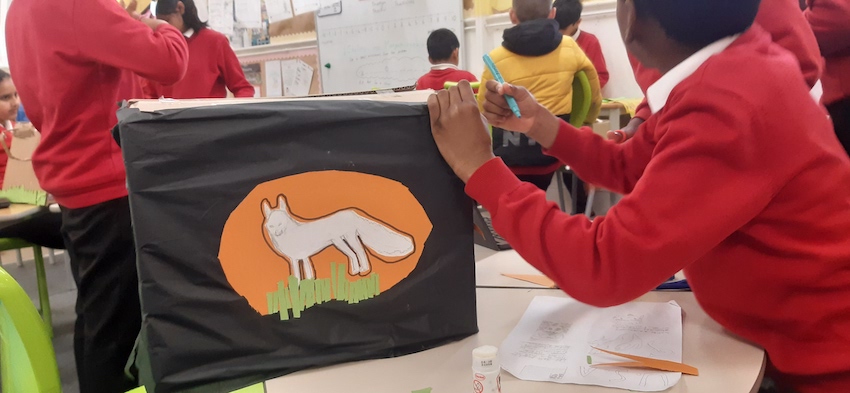
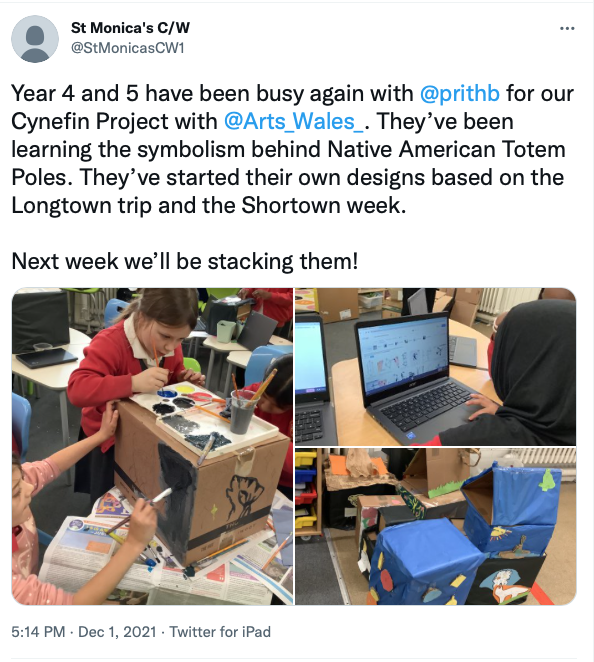
We learned about the Native American art form of Totem Poles. The children designed their own individual Totem Pole on paper and then, as a class, we designed and started to build one in 3D using cardboard boxes.
Tweet from the school below.
Underlying all this wonderful creative activity is the aim of teaching, through art, the multicultural history of Wales.
A history that is not fully mapped, nor written.
It would be easy to highlight communities arriving from the 1950’s, e.g. people from the Caribbean arriving on the Windrush, the African-Asian families fleeing Uganda, or the Yemeni seamen who settled here because of Cardiff docks.
But there’s a bigger picture as I am learning from books such as ‘Black and British’ by David Olusoga, and Miranda Kaufmann’s book, ‘Black Tudors- the untold story.’
These recent publications show the untold presence of black people in Britain since the Tudors and even the Romans.
There is an official painting that includes a black trumpet player, John Blake, in 1511, who was part of Henry VIII’s court. No special positive action scheme- he just is, because people were.
Kaufman suggests that there were not the inequalities we see now. African people were more or less equals because it was pre-colonisation, pre-Empire. And so people at the time thought very differently about people of colour.
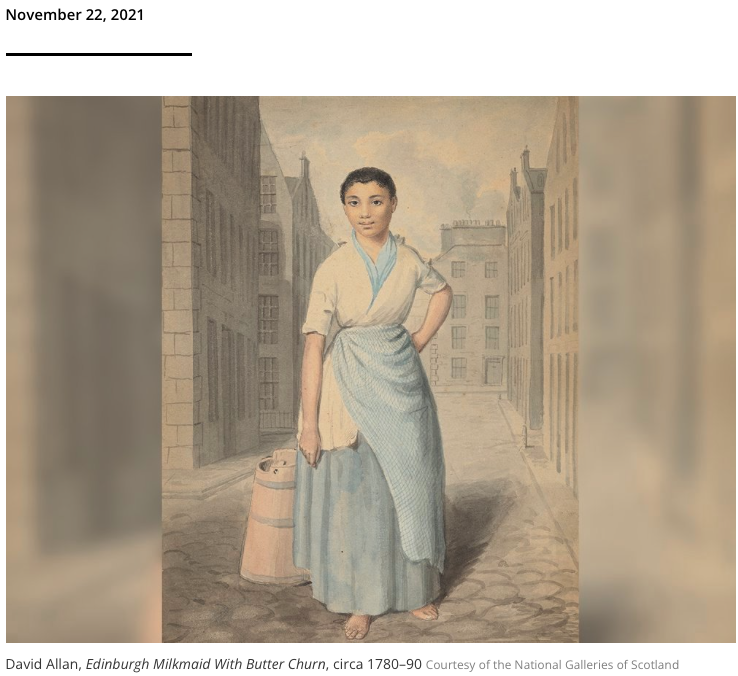
This painting was also recently discovered, a watercolour of a woman, of African descent, in Scotland in the 1700’s.
I feel sure there is more to discover in Wales, tucked away in Museum archives.
So back to my Cynefin project with the school. What story do we tell? Recent history- or bigger picture?
Or both?
